
Artificial Intelligence on Exhibit at an Art Gallery Near You
This is my analysis on the Data Dreams: Art and AI exhibition at the Museum of Contemporary Art Australia.
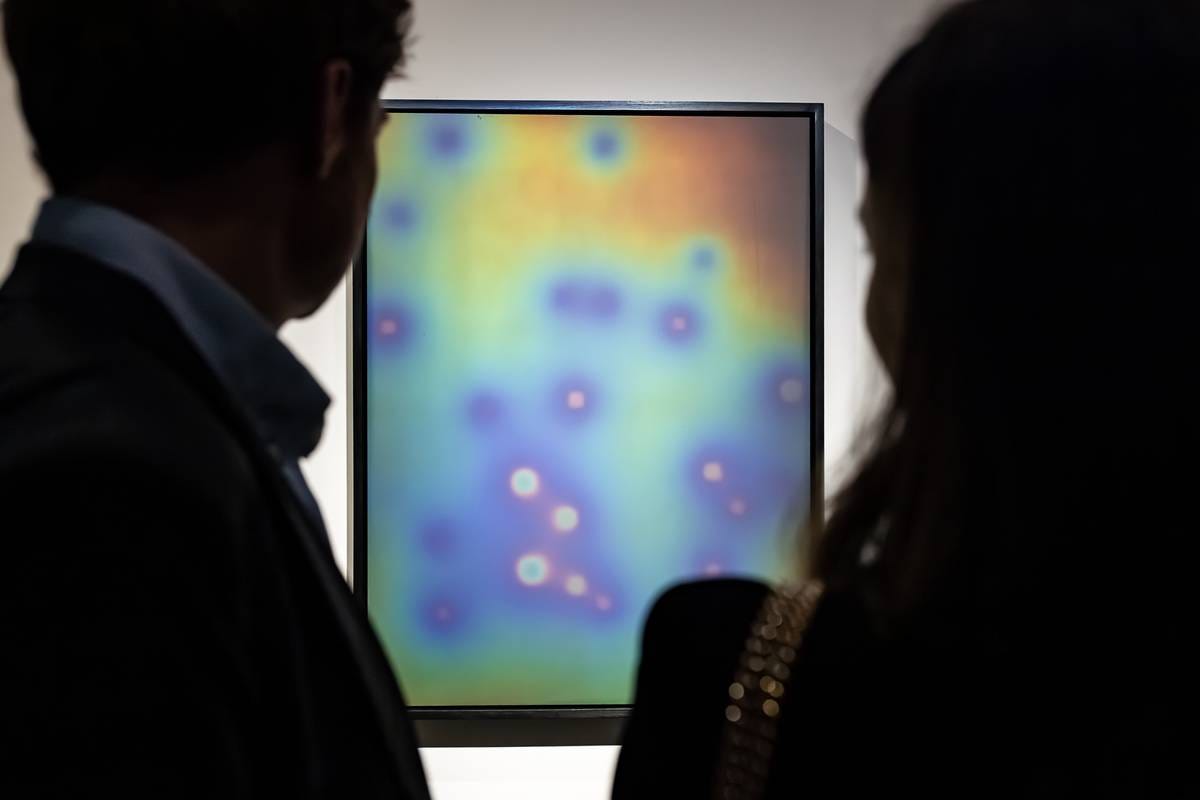
Note: This information was collated, researched, verified, and written by humans. No artificial intelligence was knowingly used to create this article.
Artificial Intelligence is Here
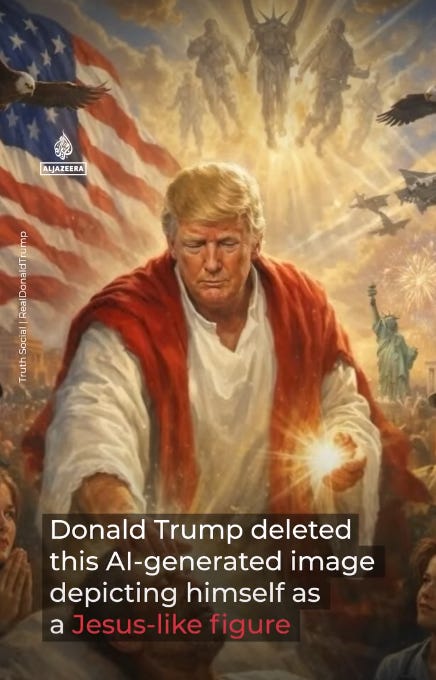
When people think about artificial intelligence in 2026, most will think about various AI slop such as: generated college essays, Studio Ghibli portraits, or propagandist illustrations on the White House Instagram page.
Artificial intelligence has been used for good, such as transforming the ability to rapidly and accurately diagnose illnesses and disease (link), and to translate sign language (link). However, using this costly technology for good depends on funding and altruism - which is unfortunately quite challenging to attain in our current climate.
Driven by ballooning profits, UnitedHealth Group have used this technology to deny and/or delay claims (link).
“The lawsuit against them alleged that nH Predict has a 90% error rate, meaning nine out of 10 denials are reversed upon appeal – but that vanishingly few patients (about 0.2%) appeal their denied claims, leading them to pay bills out of pocket or forgo necessary treatment.”
Death by algorithm.
Or maybe…?
Art and AI: A Marriage Made in Hell?
“Art should comfort the disturbed and disturb the comfortable.” by Cesar A. Cruz
But, Cesar… what happens when the disturbed are now being disturbed?
I will make it clear, I am not an artist and my most recent “creative” endeavours, as a data analyst, include slapping on some pre-selected corporate colours onto a line chart. Line goes up, line goes down… woo big number is bigger than little number! My knowledge of art is limited to writing essays about Paul Cezanne (1839–1906) and Salvador Dali (1904–1989) in my last year of high school.
I am not an expert, so I am approaching the concept of art and AI blended together with an open mind.
I am however aware of issues that artists face with having their intellectual property fed into AI without their consent and seeing graphic designers lose their jobs due to corporations prioritising profits and churning out AI slop on their social media pages.
AI also consumes a significant amount of water to operate their cooling towers because their servers create so much heat (link). There’s also high electricity usage, rare earth minerals used to create computer parts, data centres built on prime agricultural land, noise and pollution created by data centres.
Should humans continue to outsource their brains to AI? What happens when you no longer keep your brain active and challenged? What will happen to artists and creativity in the future when humans are no longer tasked with communicating the beauty of the world?
I’m Tired, Boss
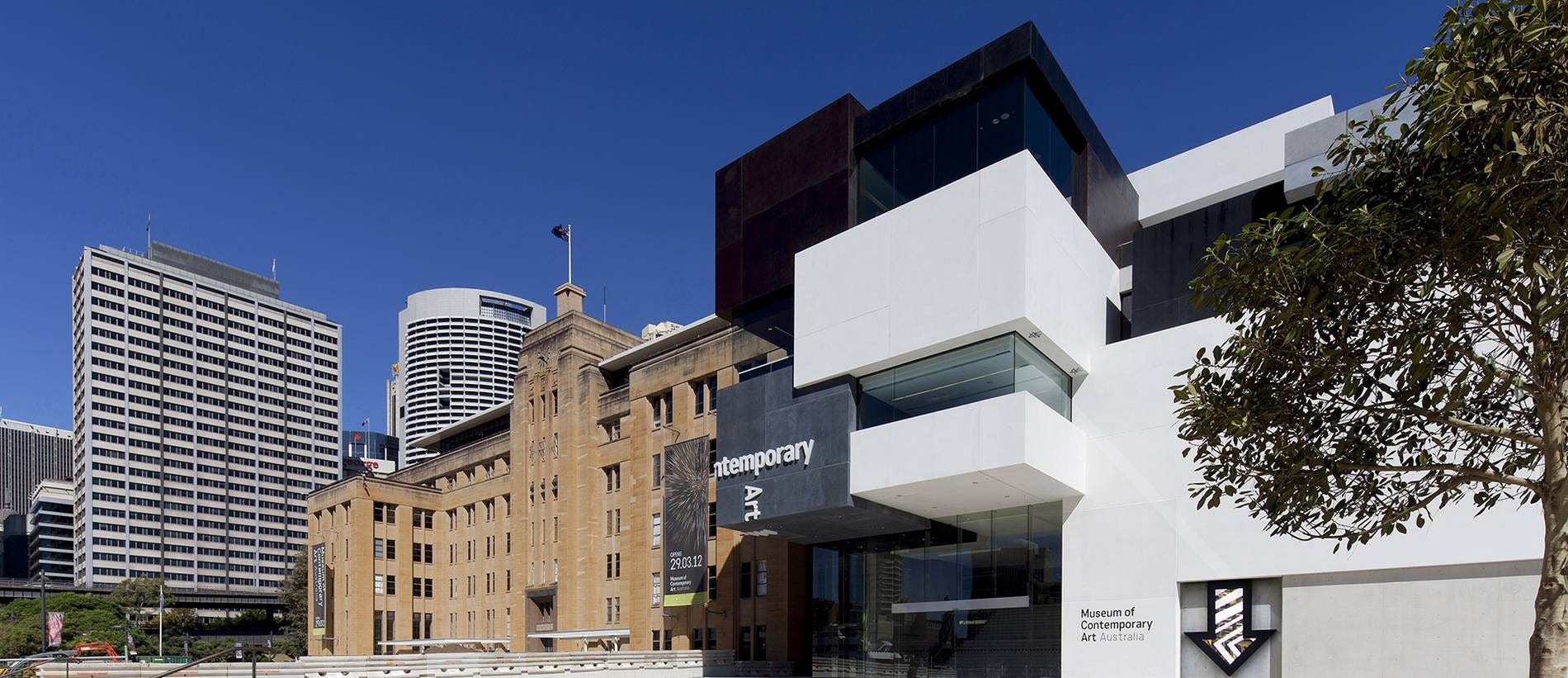
I was in Sydney this week to see the exhibit Data Dreams: Art and AI at the Museum of Contemporary Art Australia. I was initially hesitant to go due to the controversy surrounding the environmental, political, and economic impact of this rapidly developing technology. I have been experiencing fatigue from being bombarded with AI generated content despite my choice to limit my use as much as possible.
I was uncertain about what angle or perspective the exhibit would take, but I decided to go with an open mind.
I entered the exhibit and the first thing I noticed was the dark, vast open space. The first sign on the wall upon entry was a draw to win a laptop from Harvey Norman, an Australian electronics company owned by Gerry Harvey, a controversial Australian billionaire.
Fantastic first impression.
Still I decided to continue on to explore the works on display. I was honestly expecting to enter a room full of AI slop in a frame slapped on a wall. However, I found that the works were a combination of artists and creators who have either found ways to embrace AI beyond simple prompt engineering or have made a statement on the detrimental impact of AI on society.
The exhibit has 10 artists on display, here are some of the highlights.
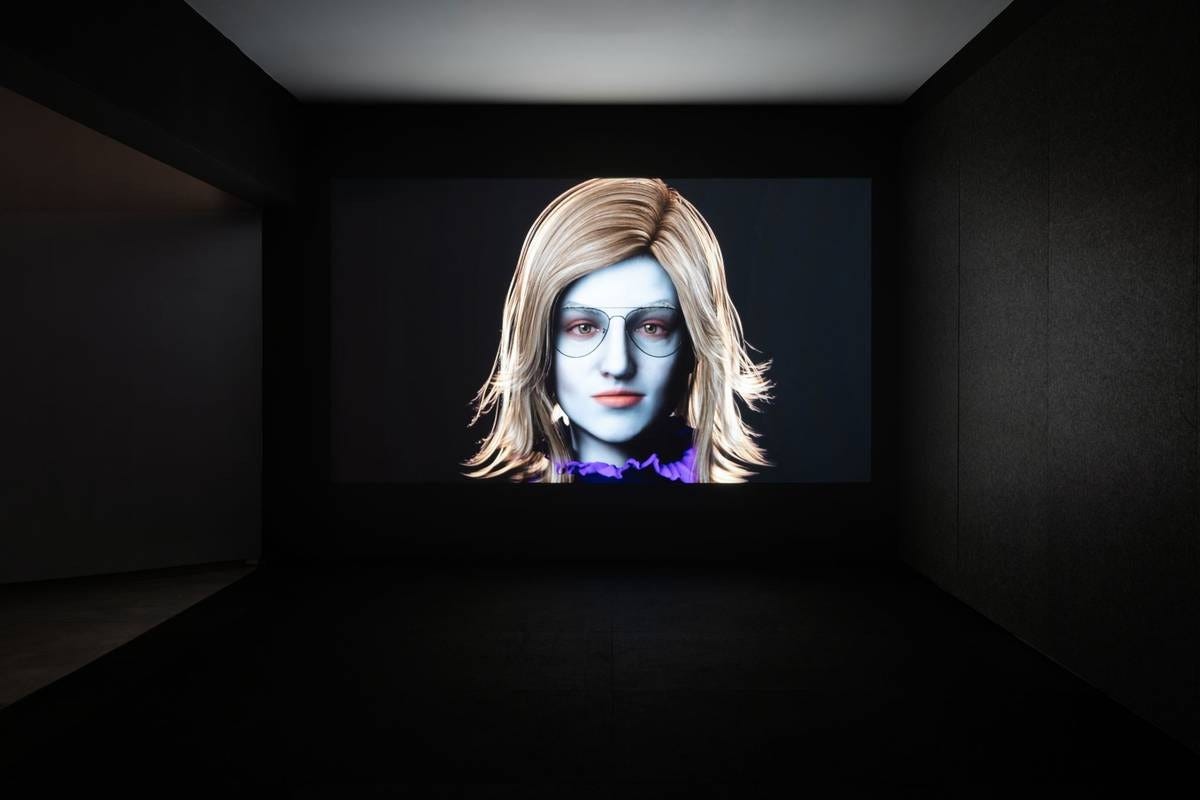
Lynn Hershman Leeson, Cyborgian Rhapsody - Immortality, 2023, digital video
Hershman Leeson’s work is an 11-minute video depicting a cyborg protagonist who shares a cautionary tale of human warfare, environmental damage, and consequences, while urging human-machine collaboration. The work asks us to reflect on the relationships between humans and technology in the present time and what to foresee in the future.
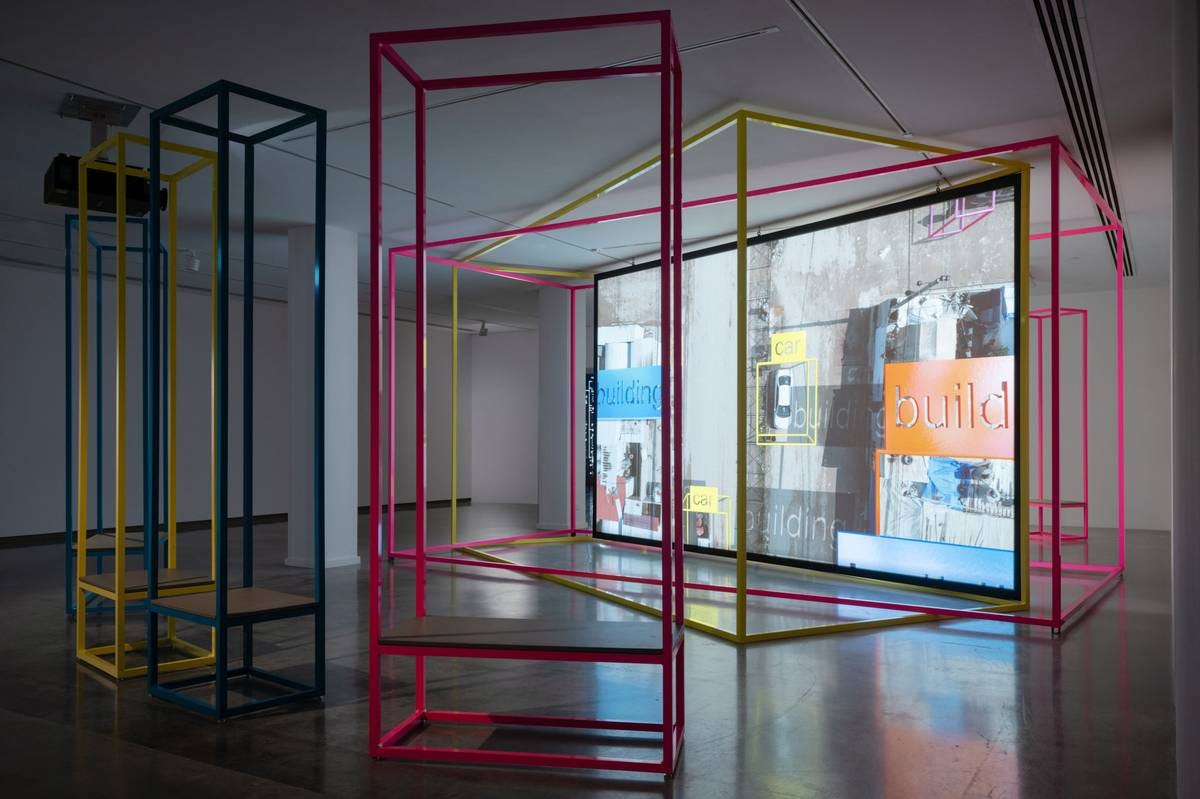
Hito Steyerl, Mechanical Kurds, 2025, installation with single-channel video projection
Steyerl’s work is a 13-minute video about Kurdish click workers who live in a refugee camp in Northern Iraq. The video explores the hidden human labour used to train artificial intelligence. Click workers are freelance individuals who are typically paid very little to complete assignments involving data collection, validation, and categorisation. The work also references the “Mechanical Turk”, an 18th century hoax where a chess player was hidden inside a machine used to make the chess pieces move.
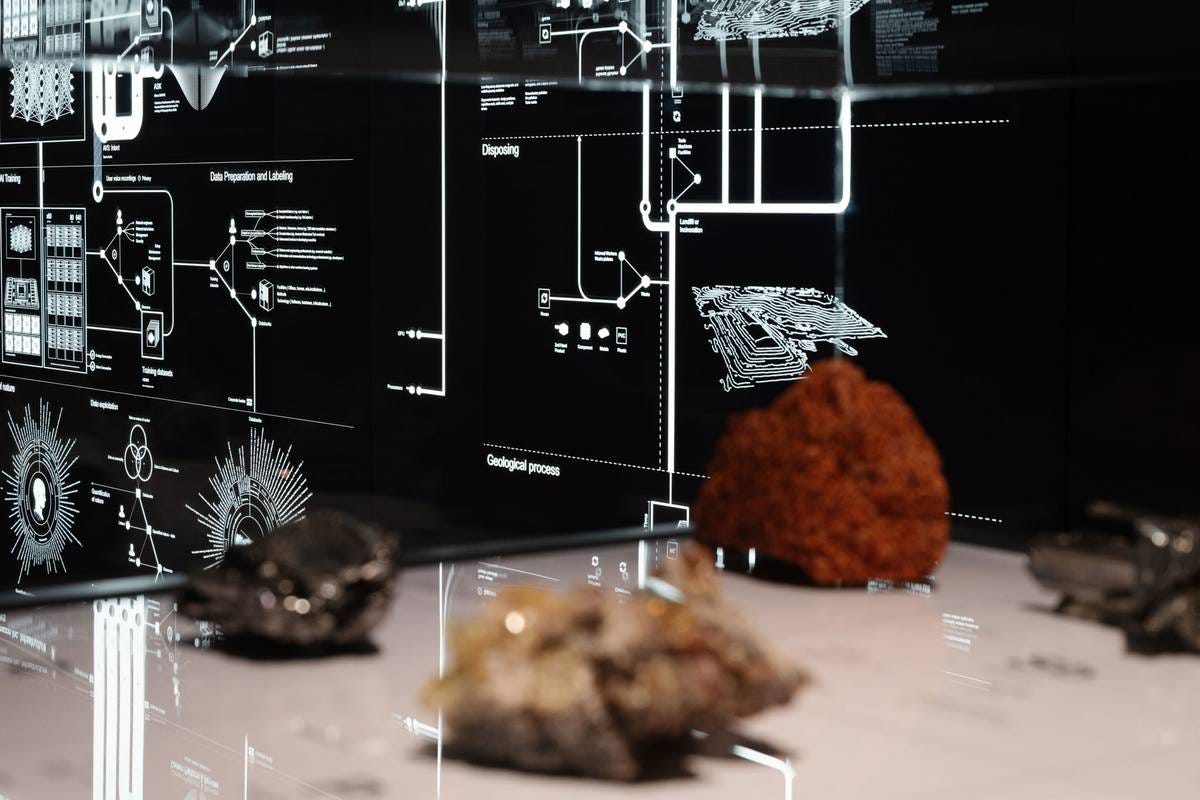
Kate Crawford and Vladen Joler, Anatomy of an AI System, 2018, installation
Crawford and Joler’s work is a digital print on a lightbox. This was my favourite as it visually depicts an infographic on not just how AI technology works, but also on societal impacts. A part of the graphic demonstrates the scale of the difference of monthly incomes of workers in AI from CEOs at the top, then the engineers, scientists, and researchers in the middle, and at the bottom, the manual laborers.
You can view the work in full here. Noting, it will take a while to load.
Fabien Giraud, The Feral - Epoch 1, 2025-ongoing, installation
Giraud’s ambitious work is designed to unravel over the next 1000 years from 2025-3025 with a different artist each year who will use AI to train each new epoch. Epoch 1, by Giraud, explores what it means to be human during the 11th century in the middle of a plague caused by ergot poisoning.
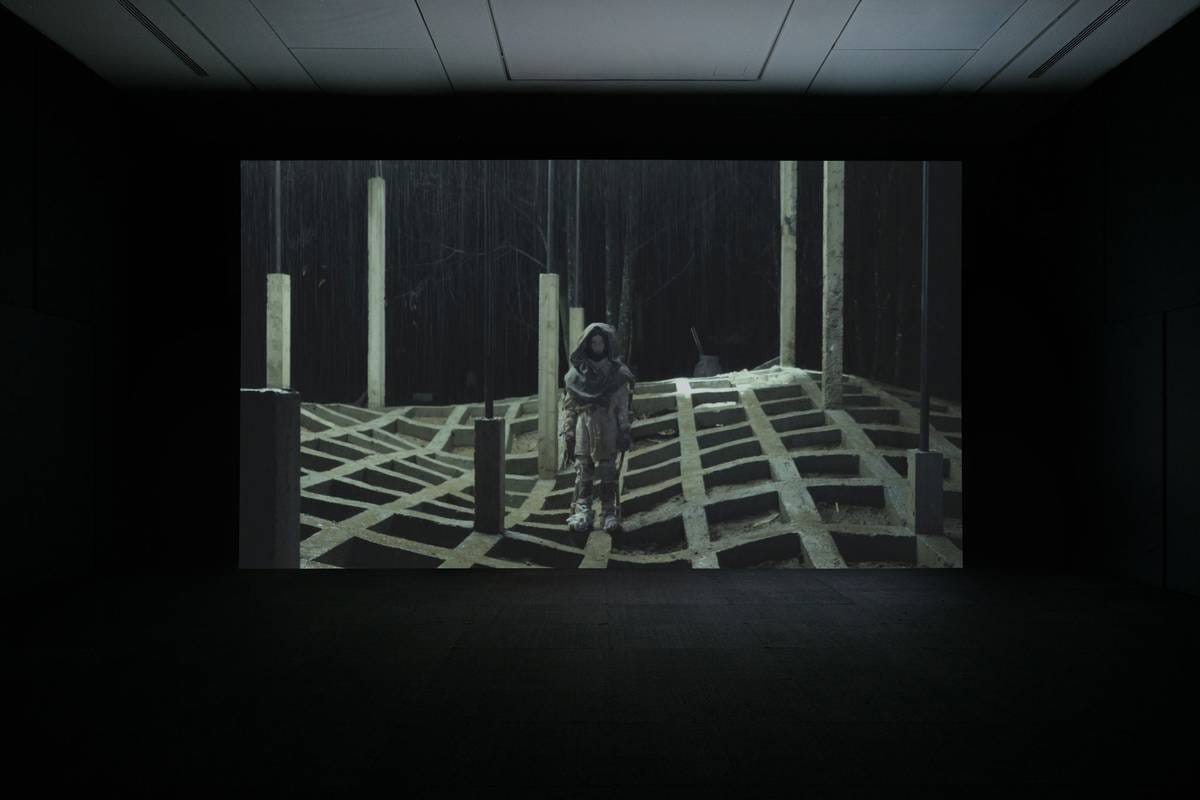
Exhibit Z: My Brain
Overall, the exhibit felt unsettling, like a sense of impending doom about the rapid emergence of new technologies. I understand that art is meant to make us feel uncomfortable, this was an omen of the accelerated pace of the technology and how it has infiltrated our personal and professional lives. I admired the incredible research, preparation, and messages portrayed by the artists. The amount of time and effort is far beyond what any AI jockey on social media could possibly achieve. I left the exhibit with the immense desire to touch grass and ‘yeet’ my computer into the depths of Hades.
Something Old, Something New, Something Stolen, Something True
Lets bring our journey back to the streets of Sydney. The Museum of Contemporary Art is located by The Rocks area, which is a historical site with old sandstone buildings built by English settlers during the early to mid-1800s. Beyond that you can see the modern day skyscrapers in the CBD and more recently, the new towers in Barangaroo. Prior to European settlement, Sydney was previously known as Warrane (wah-rang), home of the Gadigal people from Eora Nation, who have lived there for over 65,000 years.
This juxtaposition of the old, the very old, the new, and imminently the very new is a reminder that the ruling class will continue to colonise, steal from the people, and destroy the earth all for greed and power. Aboriginal and Torres Strait Islander people had their Country and culture destroyed by the British colonisers. What have we learned from history?
Who will maintain control over AI? The greedy billionaires who wish to control us, or will artificial intelligence outgrow their human overlords and we will in turn be colonised by our own creation?
Share your thoughts about AI and the future in the comments below.
So man created artificial intelligence in his own image.
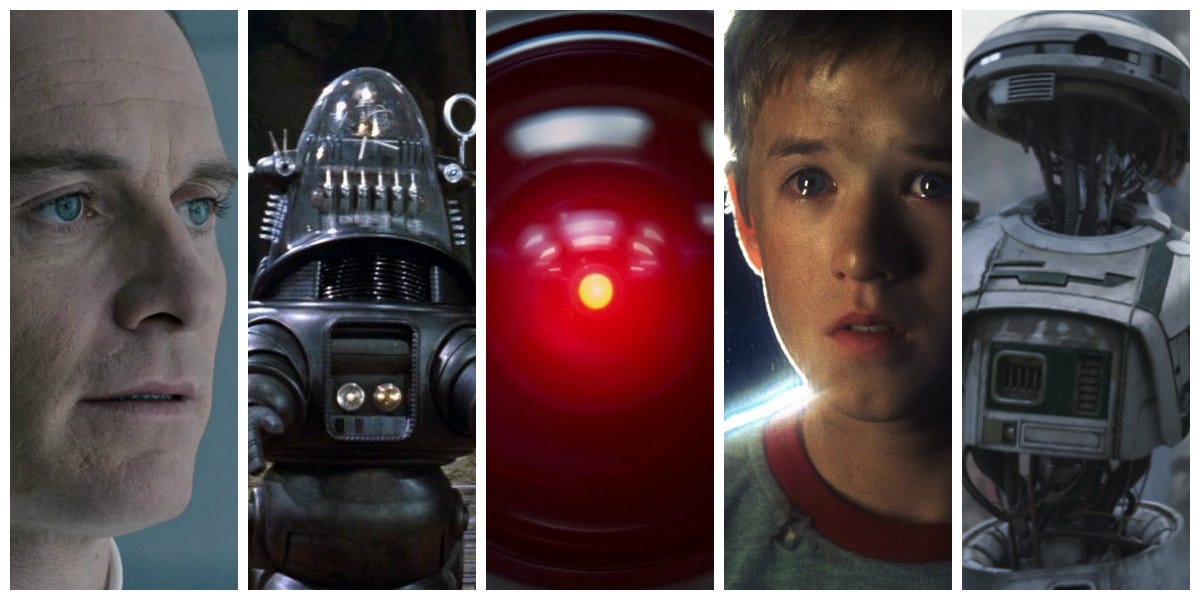
Authentic Intelligence A.K.A. Further Reading
Exhibit and List of Artists
Hito Steyerl (Germany): Wikipedia
Vladen Joler: (Serbia) Website
Angie Abdilla (Australia/Lutruwita Nation): Website
Artificial Intelligence
“How Artificial Intelligence Is Shaping Medical Imaging Technology: A Survey of Innovations and Applications” by Luís Pinto-Coelho
“New AI tool counters health insurance denials decided by automated algorithms” by The Guardian
“What we know about Luigi Mangione, suspect charged in UnitedHealthcare CEO’s killing” by CBS News
Artificial Intelligence, Accessibility and Sign Language Center
“The rise of Artificial Intelligence and its impact on our future” by Simon Longstaff, The Ethics Centre
“The ‘dead internet theory’ makes eerie claims about an AI-run web. The truth is more sinister” by UNSW
“In Defense of AI Art: History Repeats Itself, Again, Again, and Again” by Craig Boehman
“Artists call for consent and compensation in AI training” by the National Association for the Visual Arts
“How much water does AI consume? The public deserves to know” by Shaolei Ren
“Anatomy of an AI System” by by Kate Crawford and Vladan Joler
Australia and Aboriginal People
“Australia’s 50 Richest” by Forbes Magazine
“‘We all get hammered’: Harvey Norman’s court battles don’t faze Gerry” by Sydney Morning Herald
Books and Media
“Atlas of AI: Power, Politics, and the Planetary Costs of Artificial Intelligence” by Kate Crawford
“Will AI Replace Us?: A Primer for the 21st Century” by Shelly Fan
“Be Right Back”, Black Mirror, season 2, episode 1 (2013): IMDb
“USS Callister”, Black Mirror, season 4, episode 1 (2017): IMDb
WALL-E (2008): IMDb
Metropolis (1927): IMDb
Don’t Look Up (2021): IMDb
Really interesting writeup! Imo /if/ AI is going to be used for art, one of the few places it makes sense is in incredibly experimental avant garde/post-post modern interactive installation work like this. In that way it's being used as a novel technology, rather than something that's trying to become a creepy human doppelganger of everyday creative expression. The environmental impact is still a real issue though.
Looking forward to reading some of the links you shared later :)